Football pitch maintenance in Singapore comes down to five things: keeping the grass healthy, keeping the surface level and safe, keeping water moving off the pitch, repairing high-wear zones before they fail, and keeping markings and perimeter usable. On natural grass the work runs continuously, because there is no off-season here. On artificial turf the work is different in kind, not simply lighter.
Most Singapore pitches fail in the same two places for the same reason. Goalmouths go first, the centre circle second, and the cause is almost always play on saturated ground with no scheduled recovery.
What Does Football Pitch Maintenance Actually Cover in Singapore?
Routine work, weekly or fortnightly: mowing at the correct height for the species, divot repair after matches, debris clearance, line marking, and a walk-over inspection for hazards. Mowing height matters more than people expect – cut too low in a tropical climate and you shorten the roots, weaken the plant and invite weeds.
Periodic work, a few times a year: aeration to relieve compaction, dethatching to clear the organic mat, top dressing to restore levels, fertilisation guided by soil tests, and overseeding into worn areas. Goalmouth reconstruction sits here, timed to a break in fixtures.
Remedial work, in response to failure: drainage flushing or repair, regrading a low area that holds water, replacing turf beyond recovery, or treating a disease outbreak.
BSG’s field maintenance service covers this scope for football pitches. Worth noting for anyone budgeting: routine work alone will not hold a pitch together. Periodic work keeps a surface playable over years, and it is the first thing cut when budgets tighten.
Seasonal and Climate Considerations: Maintaining a Football Field in Singapore’s Heat and Rain
There is no winter shutdown here, so grass grows all year and wears all year with no dormant season to renovate in. You have to manufacture recovery windows rather than inherit them.
The climate still has a usable shape. Singapore’s long-term mean annual rainfall is around 2,113mm across roughly 171 rain days, with the wetter phase of the Northeast Monsoon typically November to January and February usually the driest month, according to the Meteorological Service Singapore.
February to March, the drier phase. The best window for major renovation. Deep aeration, heavy top dressing, goalmouth reconstruction and overseeding all establish better when you control irrigation instead of fighting rainfall.
April to October. Steady routine maintenance. Regular aeration to stay ahead of compaction, disease monitoring through humid spells, and split fertiliser applications at lower rates, since heavy feeding before a downpour largely leaches away.
November to January, the wettest phase. Damage limitation. Restrict play on saturated ground where fixtures allow, watch for standing water, keep drain inlets clear. Compaction inflicted now shows up as waterlogging six months later.
Heat adds its own problem. Sustained high temperature with high humidity raises disease pressure, especially where irrigation runs in the evening and leaves the surface wet overnight. Water early morning instead, deeply and less often, which drives roots downward. One compliance point catches facilities out: standing water is a potential mosquito breeding habitat, and the National Environment Agency takes action against premises owners where breeding is found.
Maintaining a Natural Grass Pitch vs. an Artificial Turf Pitch in Singapore – Key Differences
The common assumption is that artificial turf removes maintenance. It replaces one programme with another.
Natural grass is a living system, so the work is agronomic: soil chemistry, root depth, thatch, compaction, disease and recovery rate. Wear repairs itself if you give the plant the conditions and the rest to do so. It also has a usage ceiling, generally around 20 to 25 hours of play a week before degradation outpaces recovery.
Artificial turf does not recover, it only wears. The work is mechanical: brushing to keep fibres upright, decompacting and redistributing infill, deep cleaning to remove organic debris, seam repair, and periodic infill top-up. Skip the brushing and fibres lie flat while infill compacts, hardening the surface and raising shock-absorbency readings. That is an injury risk, not a cosmetic one.
Singapore’s climate creates a specific synthetic-pitch problem: organic debris. Leaf litter, seeds and dust settle into the infill and decompose in place under constant warmth and humidity, holding moisture, encouraging moss and algae, and reducing drainage through the carpet. Synthetic surfaces also run considerably hotter under tropical sun, which affects afternoon scheduling for youth football.
On cost, natural grass typically runs S$30,000 to S$50,000 a year to maintain against S$15,000 to S$25,000 for artificial turf. Artificial carries a replacement liability natural grass does not, since the carpet has a finite life of roughly eight to twelve years under heavy use. Facilities holding FIFA Quality or FIFA Quality Pro certification have a further obligation, as those marks depend on measured performance characteristics that maintenance directly affects.
Common Football Field Problems in Singapore and How Professional Maintenance Addresses Them
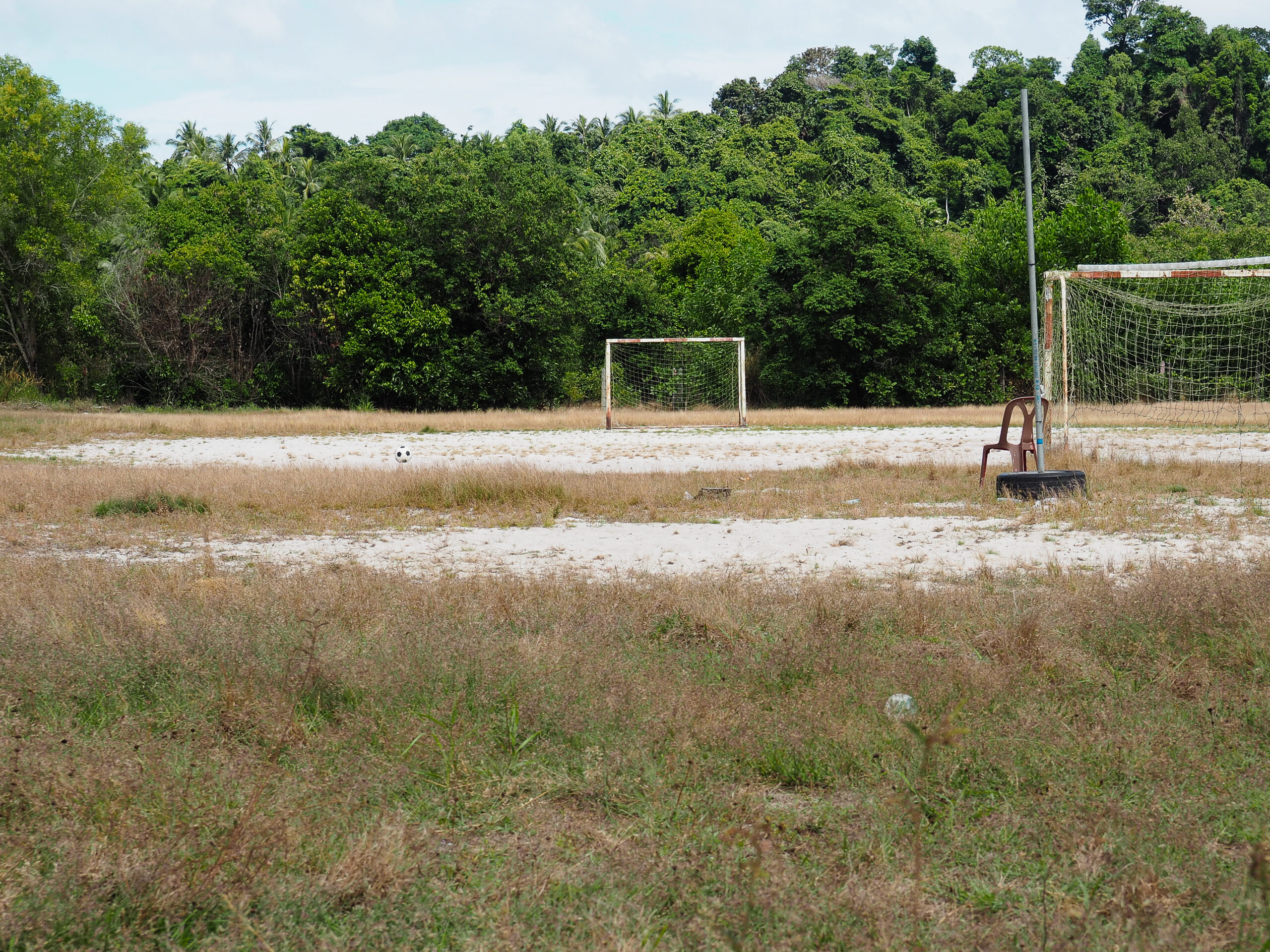
Bare goalmouths. Goalmouth-specific aeration and top dressing, overseeding, and rotating goal positions in training. Waiting until it is bare soil makes reconstruction the only option.
Waterlogging after rain. Usually compaction, thatch over 15mm, blocked subsurface drains, or drifted surface levels. Diagnose first, because adding sand to a compaction problem achieves nothing.
Thin grass in shaded areas. Raise mowing height there, reduce traffic, and consider selective tree pruning to increase light penetration.
Uneven surface and trip hazards. Regular top dressing and rolling restore levels; annual level surveys catch drift early.
Weed invasion. Year-round germination fills gaps within weeks. The durable answer is turf density, not repeated herbicide.
Fungal disease. Adjust irrigation timing, raise mowing height, improve airflow, and treat when monitoring shows a threshold crossed.
How to Build a Football Field Maintenance Schedule That Actually Works
Start from usage, not a template. Count actual hours of play per week, including training and PE, and note which areas absorb it. Then:
- Set the renovation window first. Pick the period with fewest fixtures, ideally the drier February – March phase, and protect it.
- Schedule aeration at fixed intervals, not when the pitch looks bad. Two to four times a year minimum, quarterly or more for heavy use.
- Test soil annually and let results set the nutrition programme.
- Put goalmouths on a continuous cycle rather than treating them as an end-of-season job.
- Inspect drainage annually, and after any storm leaving water standing more than a few hours.
- Define a wet-weather play policy. Deciding in advance when the pitch closes prevents most compaction damage.
- Record everything. Without records you cannot tell whether the programme is working or just expensive.
FAQ: Football Field Maintenance for Singapore Schools, Clubs, and Operators
How much does football pitch maintenance cost in Singapore?
Natural grass typically S$30,000 to S$50,000 annually, artificial turf S$15,000 to S$25,000, depending on size, usage hours and current condition.
How many hours a week can a natural grass pitch take?
Roughly 20 to 25 hours under good management. Beyond that, wear outpaces recovery regardless of maintenance quality.
How long should a pitch rest after renovation?
Deep aeration with top dressing needs a few days to a week. Goalmouth reconstruction and overseeding need two to four weeks before match use.
Can a badly degraded pitch be recovered without full reconstruction?
Often, yes. Compaction, thatch, blocked drains and thin coverage respond to a structured programme over one to two growing cycles.
How often should artificial turf be brushed?
Weekly to fortnightly for regular use, with deeper decompaction and cleaning several times a year. Singapore’s organic debris load pushes deep-clean frequency above temperate guidance.
Who is responsible for pitch safety at a school or club?
The facility operator. Documented inspections and a maintenance record are the practical evidence that surface safety has been managed.
If your goalmouths are bare or your pitch is holding water, the starting point is an assessment of the surface and what sits underneath it. BSG Landscape & Construction has maintained Singapore grounds and sports surfaces since 2003. See our past projects or get in touch for a site visit.